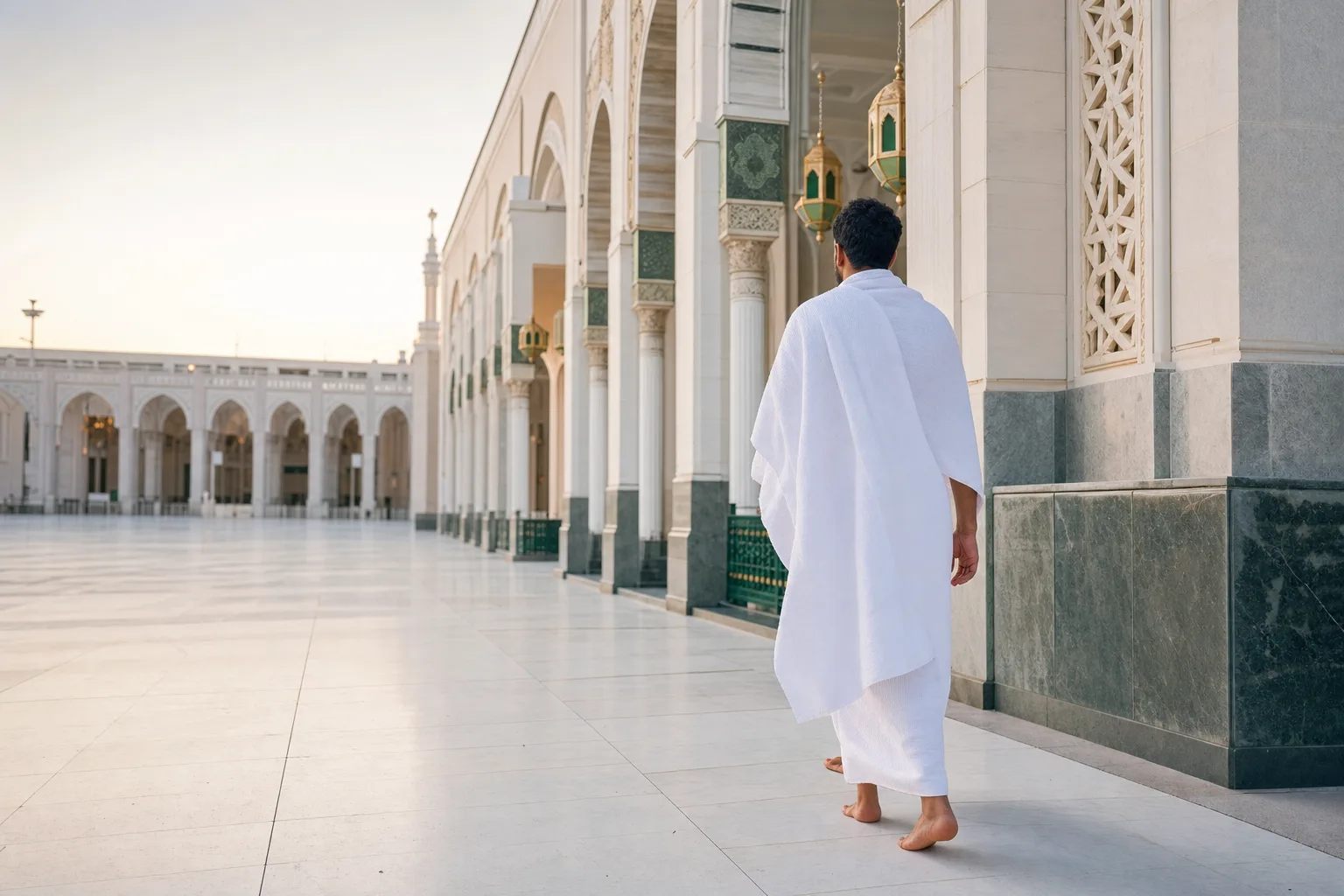
How to Perform Umrah for Men
A calm, chronological guide explaining what to prepare, what to do at each stage, how to count correctly and which practices are specific to men.
The complete Umrah sequence at a glance
Enter ihram at the miqat, perform seven rounds of tawaf, complete seven laps of sa’i from Safa to Marwah, then shave or shorten the hair. Once the final hair step is completed, the Umrah is complete and the restrictions of ihram end.
Fiqh note: This practical guide follows the broad sequence published by official Saudi pilgrim resources. Schools of Islamic law differ on some details. For uncertainty, illness, menstruation, missed actions or penalties, consult a qualified scholar you trust.
Visual route
Six stages from preparation to completion
Before the miqat
Prepare body, clothing and luggage; learn the restrictions before the journey begins.
Ihram and intention
Enter the sacred state at the miqat and begin reciting the talbiyah.
Tawaf: 7 rounds
Keep the Kaaba to your left and complete seven counterclockwise circuits.
Two rak’ahs and Zamzam
Pray where safely possible without blocking movement, then drink Zamzam if available.
Sa’i: 7 laps
Begin at Safa, finish at Marwah, and count each one-way journey as one lap.
Shave or shorten
Remove hair across the whole head to exit ihram.
Before travel and miqat
Prepare before entering ihram
Do practical preparation before the restrictions begin: bathe, attend to nails and unwanted hair, pack accessible footwear, learn your miqat and keep the ihram items in hand luggage.
Men’s clothing
Wear the izar around the lower body and rida over the upper body. Secure them before travel and carry spare clips or a belt that does not create avoidable difficulty.
Miqat planning
Know which miqat applies to your route. If flying toward Jeddah for Umrah, be ready before the aircraft reaches the miqat; do not wait until landing. Follow the airline announcement while allowing enough preparation time.
Pack within reach
- Ihram clothing and suitable footwear
- Unscented essentials
- Medication and identification
- Phone, power bank and hotel details
- Small secure bag for valuables
Do not overcomplicate it
Ihram is first a sacred state entered through intention, not merely clothing. Prepare the clothing earlier, but make the intention and begin talbiyah at the correct boundary.
Stage 1
Enter ihram and begin the talbiyah
1. Be ready before crossing the miqat
Complete washing and clothing preparation beforehand. If traveling by air, keep listening for the miqat announcement.
2. Make the intention for Umrah
Intend in your heart to enter Umrah and say “Labbayka ‘Umrah” (Here I am for Umrah). Intention belongs to the act of entering ihram; it is not necessary to announce a long personal formula.
3. Recite the talbiyah
“Labbayk Allahumma labbayk. Labbayka la sharika laka labbayk. Innal-hamda wan-ni‘mata laka wal-mulk, la sharika lak.”
Meaning: Here I am, O Allah, here I am. You have no partner. Praise, blessing and sovereignty belong to You; You have no partner.
Men recite audibly without disturbing others. Continue until beginning tawaf.
While in ihram
Remember the main restrictions
Avoid fragrance
Do not intentionally apply perfume or scented personal products after entering ihram.
Hair and nails
Do not deliberately remove hair or clip nails until the rite is completed, except where a valid ruling applies.
Marriage and intimacy
Marriage contracting and marital intimacy are prohibited while in ihram.
Harm and arguments
Avoid hunting, needless harm, abusive speech and disputes; protect the calm purpose of worship.
If a restriction is broken through need, accident or forgetfulness, do not guess the consequence from social media. Ask a qualified scholar with the exact facts.
Stage 2
Perform seven rounds of tawaf
Enter calmly, follow official directions and do not force your way toward the Black Stone. Wudu requirements and what to do if it breaks have scholarly detail, so follow the guidance you trust.
How to begin
Align with the Black Stone, keep the Kaaba on your left, gesture toward it and say “Allahu Akbar”. Begin moving counterclockwise. Physical contact is not required, and harming people to reach it contradicts safe worship.
Count every full circuit
Each return to the Black Stone line completes one round. Continue until seven are complete.
What to recite
Make dhikr, recite Qur’an and ask Allah sincerely in any language. There is no requirement for a separate fixed dua for every round. Avoid reading from a phone while colliding with others.
Practice specific to men
For this tawaf, men expose the right shoulder through idtiba and, when able and safe, perform ramal in the first three rounds. Walk normally for the final four. Cover both shoulders again after tawaf.
After tawaf
Prayer, Zamzam and moving to Safa
Pray two rak’ahs
Pray two rak’ahs after tawaf where safely possible. Do not block circulation or insist on standing directly behind Maqam Ibrahim when crowded.
Drink Zamzam
Drink Zamzam if accessible, make dua, then follow signs toward Safa. Keep moving with the crowd and never walk against the directed flow.
Stage 3
Complete seven laps of sa’i
Begin at Safa
Face toward the Kaaba as practical, praise Allah and make dua. Then walk from Safa toward Marwah.
Count one direction as one lap
The seventh lap finishes at Marwah. Tawaf rounds and sa’i laps are counted differently only in their physical shape; in both cases the required count is seven.
At the green markers
Men who are able move at a faster pace between the green markers, then return to normal walking. Do not run if it risks a fall or harms others.
Final stage
Shave or shorten the hair
After sa’i, shave the entire head or shorten hair from across the whole head—not only one small area. Use a licensed barber or a clean personal tool. Once this is done, the Umrah is complete and you exit ihram.
Do not change out of ihram early: the restrictions remain until the required hair step has been completed.
Avoid confusion
Common mistakes to prevent
Passing the miqat without entering ihram when intending Umrah
Thinking special words are required for every tawaf round
Pushing others to touch the Black Stone
Losing count because no simple counting method was chosen
Counting Safa to Marwah and back as one sa’i lap
Following men-specific practices on the women’s guide, or vice versa
Cutting hair before all seven sa’i laps are complete
Treating safety, wheelchair use or rest as a lack of devotion
Plan the practical journey
Need transport to your hotel or miqat?
Tell us your pickup point, group size, luggage and required route. We can help arrange private transport while you focus on preparing for worship.
Clear answers
Umrah FAQs for men
What do men wear for Umrah?
Before crossing the miqat, a man entering ihram removes ordinary fitted clothing and wears the izar and rida. Footwear should leave the ankles and much of the upper foot uncovered. Ask a trusted scholar about individual circumstances.
When should a man expose his right shoulder?
Idtiba—placing the upper cloth beneath the right armpit so the right shoulder is exposed—is associated with the tawaf of Umrah, not the entire period of ihram. Cover both shoulders again after tawaf, especially for prayer.
Does a man have to run during tawaf?
Men may perform ramal, a brisk short-stepped walk, during the first three rounds when able and when it is safe. Do not push, harm others or attempt it when crowds or health make it unsafe.
Do men run between Safa and Marwah?
Men who are able move faster between the green markers during each relevant passage. Outside that marked area, continue at a normal pace. Safety and avoiding harm take priority.
Must a man shave his head after Umrah?
A man exits ihram by shaving the whole head or shortening hair across the whole head. Shaving is generally regarded as more virtuous, but trimming completes the rite.
Can a bald man complete the hair step?
A man with no hair has no hair to remove. Because detailed rulings can vary by circumstance, ask a qualified scholar for personal guidance.
Sources and review note
The sequence and practical distinctions were checked against the official Nusuk Umrah Journey and the Saudi Ministry of Hajj and Umrah’s Umrah and Visit Guide. Operational rules can change; personal religious questions should be referred to a qualified scholar.
